
THE NATURE
REPORT
January
2008
Home page
THE NATURE
REPORT
January
2008
Home page
|
Happy New Year to everyone, I hope it finds you well or at least better than the weather that we have been having. Whenever I am thinking of paying Phil a visit to try and get some photographs for the website, one of the first things I do is to look out of my window to see what the weather and the sky are like. Usually I can tell whether it is worth the visit or not. Frustratingly over the last couple months, my free time has not coincided with the best of the weather (what little there has been).
No doubt you can guess which way the storm was heading, no visit on that day.
When these clouds are present the sky is sometimes described as a mackerel sky as the clouds can give the appearance of the banded markings on a type of fish known as a mackerel.
Regrettably it is not proof of ET or some covert stealth aircraft, it is actually a bird (or maybe???).
This one was lucky that it was me shooting it with a camera, Phil and other members of the farming community consider them to be a pest and do not use cameras to shoot them.
In the United States they are commonly referred to as "Stink bugs" due to the fact that they give of a pungent odor as a defensive measure. They are harmless insects, most feeding on plant sap although some species will feed on the likes of caterpillars.
They and other small birds should also benefit from Phil's latest housing project in the form of nest boxes. Several dozen of these simple boxes have been put up around the farm in order to encourage the bird population.
This one is in its winter plumage and lacks the black head of its summer plumage from which it takes its name.
Actually, love them or hate them Phil is obliged under section 1 of the Pests Act 1954 to, shall I say, "control" the rabbit population on his land. It may be difficult, particularly for people living in urban areas to appreciate the fact, but these "cute" little animals are a serious pest, damaging crops and carrying disease. They are not a native of the UK and it was originally thought that they had been introduced by the Normans, however the discovery in 2002 of rabbit remains in Norfolk indicates that it could have been the Romans. I think they're cute anyway:-)
This natural resin can trap unwary insects and other small creatures, over time the resin hardens and if the right conditions occur over millions of years it can fossilize to become amber. Inside you can find the almost perfectly preserved remains of the trapped insects. It was made famous in the film "Jurassic Park" when blood from the stomach of trapped mosquito's was used as a source of Dinosaur DNA. Just imagine if there was a mosquito that had bit Phil trapped in this, in some distant future some mad scientist could use it to resurrect him... Scary thought:-) That's it for now See you next month Andy. Back to January Journal / Home page
|
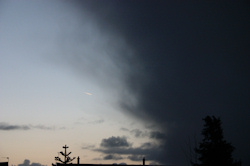 In this first photograph the sky was literally half and half. On the left half there was hardly a cloud to be seen from overhead to the horizon, while on the right the sky was covered by a huge black storm.
 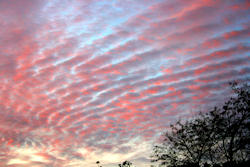 This next photograph is of a cloud type known as an Altocumulus. This photograph was taken by my son James; he described it as looking like a fingerprint in the sky.
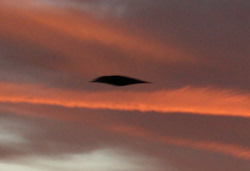 In this final photograph, again taken by my son James; he captured this strange object as it flew through his field of view just as he clicked the shutter of his camera.
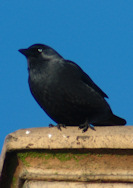 We think it was a Jackdaw, these birds are members of the crow family and this next photograph shows one sitting on the chimney of the farmhouse.
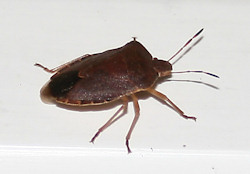 Also at the farm house, sitting on the window ledge was this Shield bug, so called because of its resemblance to the shape of a shield.
 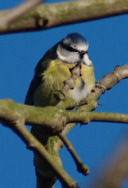 Likely to feed on our friend above, is this Blue tit.
 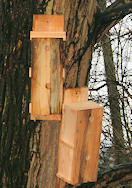 They are very common around Greenheyes and are easy to spot due to the lack of foliage on the trees and hedges at this time of year
 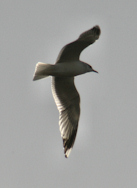 One bird that would have difficulty in using this accommodation is this Blackheaded gull.
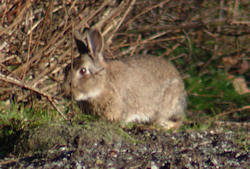 Eyes back on the ground and I spot this cute little bunny (don't you think so Phil?:-) He loves them really (usually in a pie).
 Finally, this photograph shows a large blob of sap oozing from the bark of an apple tree.