
THE NATURE
REPORT
April
2006
Home page
THE NATURE
REPORT
April
2006
Home page
|
As you may have read in Phil's main report April this year was reasonably dry giving me an opportunity to have a couple of nice strolls around the farm.
They are a common sight here at Greenheyes. This one was sat upon on of the steel support beams of the silage clamp and given the time of year was probably singing to attract a mate.
A close look at this one shows that it is need of some new plumage. As you can see its feathers in places are somewhat worse for wear. Being springtime many living things are looking for mates. this can be a particularly hazardous occupation for members of some species (humans included).
Now here's the dilemma facing our enamored (love sick) male - boy wants girl, girl not interested in boy (sound familiar lads). Well like most young lads, common sense goes out of the window when there's a gorgeous girl involved and our boy here was no exception. The trouble is that he is motivated by desire, she is motivated by greed (said it was familiar) Well I had to give him full marks for persistence and after a considerable period of time and countless rebuffs he finally got his girl and she had her man!!! (there's a lesson in there lads :-). I am frequently joined on my little walks by my youngest son James and this as one of those occasions.
Here he his closing on a rabbit. Using the tree for cover he slowly reduced the distance between the rabbit and himself.
I am sure that he would have gotten a closer photograph had it not been for a moorhen that was out of sight at the base of the tree. He surprised it and its flight startled the rabbits much to his annoyance.
As soon as we moved away the parents resumed feeding their demanding of spring. If you do happen to find a nest or any animals home be very careful not to disturb it if you scare away the parents then the outcome is that the young will die. We retired to a comfortable distance and ensured that the parents continued to care for the young before we left.
Unlike our previous encounter we were upwind of this one it must have picked up our scent, and it ran for cover before we could get closer.
In this photograph part of the bank can be seen slumping into the river. This is at the spot where I have discovered some archaeological remains which are currently under investigation. As more of the bank is eroded more remains are exposed and sadly eventually destroyed. I have decided to start a new section documenting what is found and hope to have it up on the web in the near future.
Although it looks at first glance like a honey bee, it is if fact a Tawny Mining Bee. They are solitary bees and nest in the soil.
They often occur in quite large clusters around the base of rotting trees.
I have to confess that I do not know the name of this particular species of bee. Perhaps one of our readers could enlighten me.
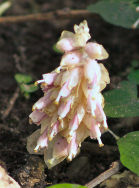
This is Toothwort also known as "corpse flower" it was given this name because it was belived that such a pale "ghostly" plant would only grow on a buried body. It has no green parts or leaves as it is a parasite and extracts its nutrients from the host plant, therefore it does not need chlorophyll that gives other plants their green colour.
This time in a more natural setting is a little wren, although it was not so vocal as its farmyard living relative.
More next month Andy Back to April Journal / Home page
|
 As
I was heading out for the cattle drive, my attention was drawn to this
wren by its incredibly (for its size) loud musical song.
As
I was heading out for the cattle drive, my attention was drawn to this
wren by its incredibly (for its size) loud musical song.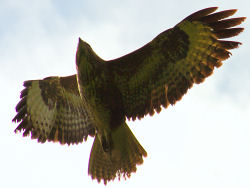 Another,
somewhat larger bird heard calling that day was a buzzard. Actually
there were six of them, the one in this photograph being the closest.
Another,
somewhat larger bird heard calling that day was a buzzard. Actually
there were six of them, the one in this photograph being the closest.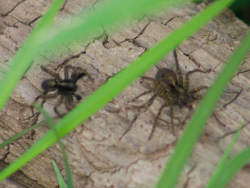 This
picture shows a pair of wolf spiders. the female is the larger spider
on the right, almost twice the size of the male on the left.
This
picture shows a pair of wolf spiders. the female is the larger spider
on the right, almost twice the size of the male on the left.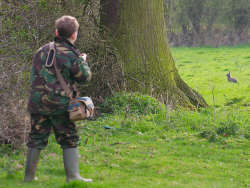 I think that he is going to be a natural at photographing nature, he
seems to have a rapport with it and wildlife.
I think that he is going to be a natural at photographing nature, he
seems to have a rapport with it and wildlife. 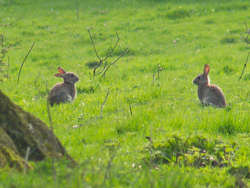 This
is the photograph that he managed to take.
This
is the photograph that he managed to take.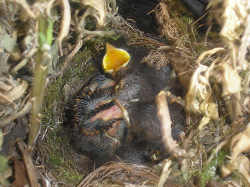 A
little further round he took this photograph of some baby robins he
found in a nest in the hedge.
A
little further round he took this photograph of some baby robins he
found in a nest in the hedge.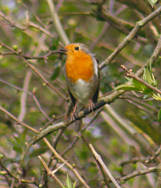 In
my photograph, one of the parents looks on as James took his.
In
my photograph, one of the parents looks on as James took his. 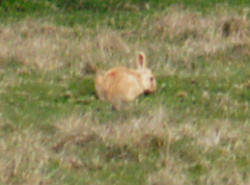 Going
back to the subject of rabbits and down towards the River Dane, we spotted
this unusual coloured "golden" rabbit.
Going
back to the subject of rabbits and down towards the River Dane, we spotted
this unusual coloured "golden" rabbit.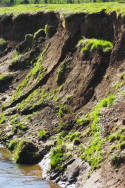 Along
the river bank, and the ongoing process of erosion continues apace.
Along
the river bank, and the ongoing process of erosion continues apace.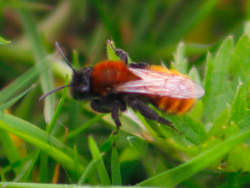 On
the grass on top of the bank I spotted this bee.
On
the grass on top of the bank I spotted this bee. 
 A
little further along, at the base of a tree was this cluster of inkcap
fungi (glistening inkcap I think).
A
little further along, at the base of a tree was this cluster of inkcap
fungi (glistening inkcap I think). A
closer at the space between clusters found yet another species of mining
bee.
A
closer at the space between clusters found yet another species of mining
bee.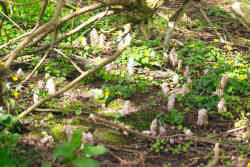
 On
the floor of a woody part of the bank I came across a carpet of rather
pale looking flowers.
On
the floor of a woody part of the bank I came across a carpet of rather
pale looking flowers. 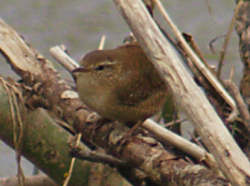 Finally
I will end this month with the same subject as I began.
Finally
I will end this month with the same subject as I began.