
THE NATURE
REPORT
March
2006
Home page
THE NATURE
REPORT
March
2006
Home page
|
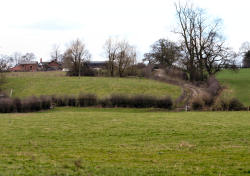
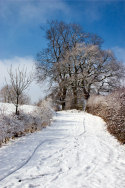
Well March is finally with us once again, and with it the beginnings of spring or as these pictures show, a late winter.
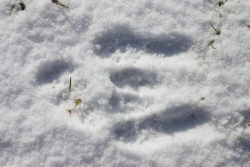
One advantage of the snow is that it enables you to clearly see that which you may not normally notice. I mean the tracks of wildlife.
Sadly at least for the humans the snow did not last long.
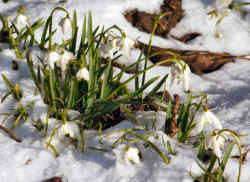
In this photograph, appropriately, Snowdrops can be seen blossoming through a thin layer of remaining snow.
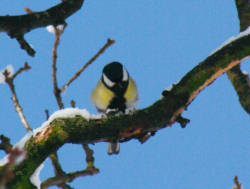
There have been large numbers of Blue Tits, Great Tits (adults may smile) and Long-tailed Tits seen so far this year.
They are Gooseander's and belong to the sawbill family of ducks. I am not 100% sure but the my be the largest in this group. The three shown here are a male (lead position) and two females. You can tell from the colour of the head the male has a dark bottle green head which may appear black from a distance (as in the photograph) while the females have a chestnut brown head.
The mallard is probably one of our most common ducks. It is around this time of the year that the mallard starts to nest so in the next few weeks I expect that I will see mum and her ducklings out for a swim on the river.
They are not the best loved of birds among fruit growers as they can do considerable damage to the likes of apple and pear trees. Indeed growers may find it necessary to shoot the birds in order to control their numbers and the amount of damage they do.
Well that's it for this month hope you've found it of some interest.
see you next month Andy Back to March Journal / Home page
|
 As
you may have seen with Phil picture in his main report for a brief period
Greenheyes became a ski resort.
As
you may have seen with Phil picture in his main report for a brief period
Greenheyes became a ski resort.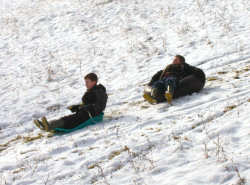 In
this photograph two of the local primates (Nathan and James) take advantage
of natures playground.
In
this photograph two of the local primates (Nathan and James) take advantage
of natures playground.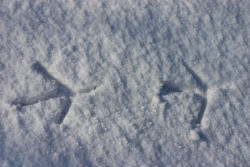
 As
the snow retreated the first true signs of spring could be seen.
As
the snow retreated the first true signs of spring could be seen.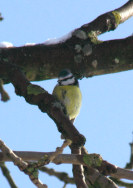
 The
snow did not appear to have affected members of the Tit family.
The
snow did not appear to have affected members of the Tit family.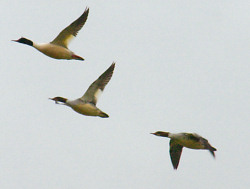 Moving
on a glance overhead caught these three birds.
Moving
on a glance overhead caught these three birds.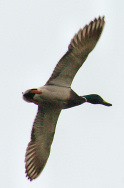 Also
flying over head was this male Mallard.
Also
flying over head was this male Mallard.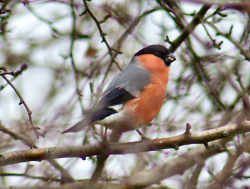 Back
to earth now and in the hawthorn hedge I spotted this male bulfinch
eating the buds.
Back
to earth now and in the hawthorn hedge I spotted this male bulfinch
eating the buds.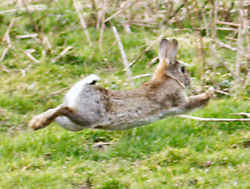 Finally
as I am returning from my walk I spot this low flying rabbit :-)
Finally
as I am returning from my walk I spot this low flying rabbit :-)