
THE NATURE
REPORT
February
2006
Home page
THE NATURE
REPORT
February
2006
Home page
|
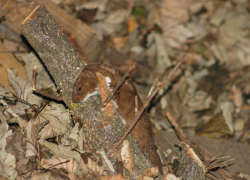
We think it had been disturbed by some excavating that was being carried out behind the shed. Weasel's are often confused with their relative the stoat. However the stoat is larger and has a distinctive black tip to its tail, the weasel's tail is all brown.
That is not good news for the cute little bunny on the right. I must point out that "cute" is not a word that Phil would use to describe a rabbit. I will leave what he would use to your imagination, he is a country gentleman after all :-)
A good sign that spring is on the way is the appearance of flowers. Amongst the first to appear are these snowdrops I found in a sheltered spot down by the River Dane. They grow from bulbs which have lay dormant in the ground over winter.
This is a Grey Squirrel. Although they are cute and entertaining to watch they can be a great nuisance, mainly by damaging trees. They can kill young saplings and damage adult trees by stripping off bark thus allowing fungal infection.
These are winter visitors from northern europe. This picture shows just two of quite a large flock.
These are a very common bird and despite its name, these days they are just as common in the middle of urban sprawl as they are in the countryside. Indeed in many towns and city's they can be, to say the least, a bit of a pest.
A member of the crow family, the magpie is unmistakable. They will feed on all kinds of food including the eggs and young of other birds. You can normally hear the harsh chatter of the magpie's voice warning of other predators. more rarely it can be heard giving quite a melodious song.
It obtains its name from the yellow-gold stripe on the crown of its head. It is tiny at approximately 3.5 inches (9cm) long. Our final bird would give the goldcrest a run for its money as the smallest bird if it was not for the length of its tail.
This year there has been a good year for sighting these birds. Locally they have become very common along with other members of the tit family. Finally we have a rather ominous looking photograph.
Thankfully it is not the evidence of a nuclear explosion that such clouds have come to represent. It is actually produce by condensation from the cooling towers of a large power station.
See you next month Andy. Back to February Journal / Home page
|
 This
Weasel was spotted climbing around in the wood shed.
This
Weasel was spotted climbing around in the wood shed.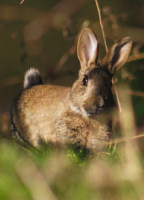 Weasels
are carnivores and are known to prey on mice, voles, rats and young
rabbits the latter being much larger than themselves.
Weasels
are carnivores and are known to prey on mice, voles, rats and young
rabbits the latter being much larger than themselves.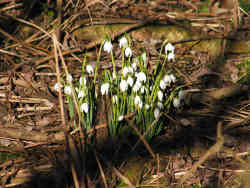
 Talking
of the river Dane, this particular morning it was flowing slowly and
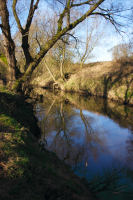
had a surface like glass as the reflection in this photograph shows.
Talking
of the river Dane, this particular morning it was flowing slowly and
had a surface like glass as the reflection in this photograph shows. Also
by the bank of the river was this pair of moorhens. They do not normally
let me get this close, but they must have had other things on their
minds this morning.
Also
by the bank of the river was this pair of moorhens. They do not normally
let me get this close, but they must have had other things on their
minds this morning.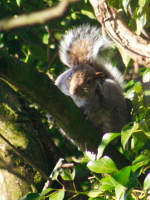 Watching
from above was this squirrel.
Watching
from above was this squirrel.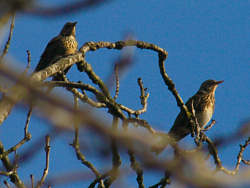 Still
in the trees, this time in the higher branches were a flock of Fieldfare.
Still
in the trees, this time in the higher branches were a flock of Fieldfare. Taking
flight from the middle of the tree was this Woodpidgeon.
Taking
flight from the middle of the tree was this Woodpidgeon.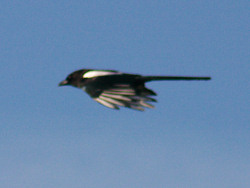 Also
taking flight out of the trees was this Magpie.
Also
taking flight out of the trees was this Magpie.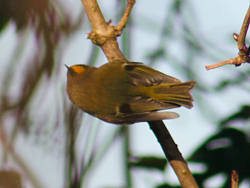 This
picture shows our smallest bird the Goldcrest.
This
picture shows our smallest bird the Goldcrest.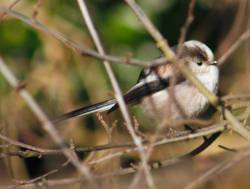 The
Long-tailed Tit has a small fluffy body with an extremely long tail
in proportion to the length of its body
The
Long-tailed Tit has a small fluffy body with an extremely long tail
in proportion to the length of its body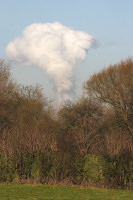 Ground
Zero for this man made, mushroom shaped cloud is approximately 20 miles
away (32 kilometers) from Greenheyes.
Ground
Zero for this man made, mushroom shaped cloud is approximately 20 miles
away (32 kilometers) from Greenheyes. 