
THE NATURE
REPORT
December
2005
Home page
THE NATURE
REPORT
December
2005
Home page
|
I had just finished working a set of night shifts and decided that instead of going straight to bed, I would grab my camera and wander down to the farm. As I set off on my wanderings I was treated to a gorgeous sunrise. After night of treating the effects of drink, drugs and the occasional genuine illness it's very relaxing to watch a spectacle of nature that most of us take for granted. This is a large bird to say the least and stands a little over 3ft tall (about 1 meter) when fully grown. It can be found almost anywhere there is water, from your garden pond (especially if its well stocked with fish) to lakes and river estuaries.
This, as far as I know, is our smallest bird. At just over 3ins (8-10cm) in length the Heron would have no problem swallowing it whole. They are quite a common sight around the Cheshire hedgerows.
In this photograph the female bird is on the front right of the picture while the brightly colored male remains discreetly, and perhaps wisely in the background undergrowth. I say wisely because these birds are known as "Game" birds and are at certain times of the year hunted.
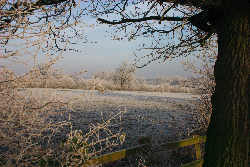
Despite the reddish brown colour of its face and back this is actually a Gray Squirrel. These are not native to the British Isles but are an import from North America. Another early morning visit towards the end of the month brought another fine day, however the temperature was a good few degrees lower.
The frost on the landscape gave it a picture postcard appearance.
The frost on this hawthorn bush had taken on the thorny appearance of its host. Giving the bush quite a fearsome look.
This is the web of the "Impaler" spider. Unlike the average spider whose webs trap there prey by the use of a sticky thread, the "Impaler" spider uses vicious spears of ice to impale any insect that should have the misfortune to fall into its web. (shame its not April).
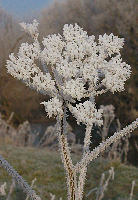
This time the flowers are of crystals of ice and within an hour they will be gone.
They appear to have been formed by,
in this case, a small twig momentarily dipping into the river, collecting
a small amount of water on its surface which was then frozen when the
twig was then exposed to the freezing air. This set were photographed by me back in 2003. I think that another part of their formation process relies on the water level in the river slowly falling as they are being created. A fact that could explain why they are not a common sight.
This is a Fieldfare and is a relative to the Thrush. During the summer it breeds in the northern forests of Europe, before moving south and wintering on farm and open woodland.
It is a very adaptable animal and these days it is not too uncommon a sight in urban areas particulary at night. I have often seen them in my local town centre when I have been on night duty (never have a camera handy though). This one had been hunting for prey and had caught and eaten a rat while I was watching (it was to far out for my camera to take a good photograph at that time). Still luck was with me, as it closed on my position it was so intent on looking for food it failed to spot me until it heard the shutter of my camera click. Well thats all for now, HAPPY NEW YEAR TO ALL More next month Andy
|
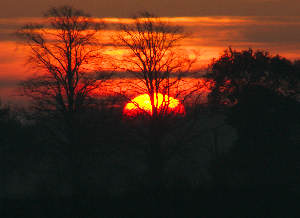 The end of another year approaches and a new day begins.
 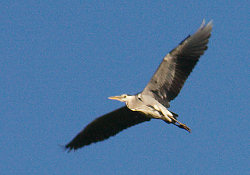 Also
out early on this particular morning was this Heron.
Also
out early on this particular morning was this Heron. At
the other end of the scale is the Wren.
At
the other end of the scale is the Wren. Another
common sight around here are Pheasant.
Another
common sight around here are Pheasant.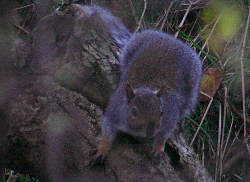 A
little further on in the woody undergrowth of
A
little further on in the woody undergrowth of 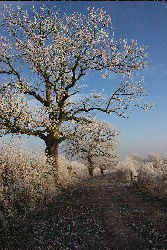
 Once
again I find that nature can put on some fine displays, despite the
cold.
Once
again I find that nature can put on some fine displays, despite the
cold.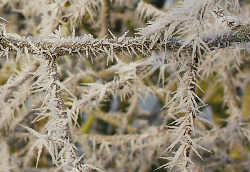 You
have probably heard of Hawthorn and Blackthorn but what about Icethorn?
You
have probably heard of Hawthorn and Blackthorn but what about Icethorn?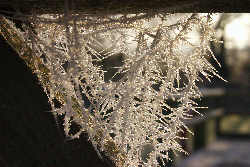
 The
flowers of this plant died weeks ago, yet with the action of the frost
it almost looks as though it has flowered once again.
The
flowers of this plant died weeks ago, yet with the action of the frost
it almost looks as though it has flowered once again.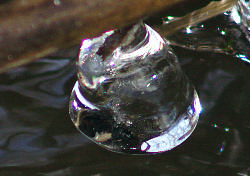 Down
along the banks of the River Dane the freezing temperature had created
these bell-like crystals of pure ice.
Down
along the banks of the River Dane the freezing temperature had created
these bell-like crystals of pure ice. this
process being repeated over and over gradually building up the bell
shape.
this
process being repeated over and over gradually building up the bell
shape. Heading
back to the farm I spotted one of our winter visitors looking for food
in the frozen ground.
Heading
back to the farm I spotted one of our winter visitors looking for food
in the frozen ground. The
final photograph this month is of our largest predator (Phil excluded)
the Fox.
The
final photograph this month is of our largest predator (Phil excluded)
the Fox. 